What Underwriters Actually See Isn't the Full Picture
.png)

.png)

Key Takeaways
- A submission tells you what the applicant wants you to know. External data tells you what the account actually looks like.
- Regulatory inspection histories, FMCSA safety ratings, PCAOB filings, and state license databases carry risk signals that never appear in standard submissions.
- The challenge isn't data availability - public records are abundant. The challenge is reconciling conflicting sources into something an underwriter can trust and trace.
- Carriers operationalizing external data enrichment report meaningful improvements in appetite fit, pricing discipline, and loss ratio outcomes.
- The future underwriting workflow treats external research as a standard input - not a manual side task for complex accounts.
There's a version of underwriting that most carriers practice today: a submission arrives, documents get reviewed, loss history gets evaluated, and a decision follows. The process is familiar, and for most accounts, it works.
But there's a quiet problem embedded in that workflow. The submission tells you what the applicant — or their broker — chose to include. It doesn't tell you what the account looks like from the outside.
That gap matters more than most underwriting teams realize.
The Visibility Problem in Commercial P&C Underwriting
Take a mid-size trucking operation applying for commercial auto coverage. The submission includes a clean loss run, a completed ACORD 130, a driver schedule, and a standard supplemental. Standard package. Nothing alarming.
But in the FMCSA's SAFER database, the carrier has an out-of-service rate trending upward over the last 18 months. Three recent driver violations that haven't worked their way into a loss run yet. A safety rating that's shifted from Satisfactory to Conditional.
None of that shows up in the submission. Not because anyone tried to hide it - but because submissions are static snapshots, assembled by brokers who may not have checked the DOT data themselves.
The same pattern plays out across lines. A CPA firm applying for professional liability carries a clean five-year loss history. But a search of state licensing boards reveals that two partners are operating under active disciplinary proceedings in their home state. PCAOB records show the firm recently picked up three public company audit clients — a significant change in risk profile that no supplemental form would have captured.
A manufacturing account shows steady revenues and a solid safety record. A regulatory inspection database shows a facility citation for an unreported chemical storage violation six months prior.
These are not edge cases. They're the kind of signals that routinely exist in public records and authoritative data sources — and routinely don't make it into the underwriting file.
Why Public Data Is Hard to Use
The instinct when confronted with this problem is to ask: why aren't underwriters just checking these sources themselves?
Some do, for large accounts that warrant the investment. But the economics don't scale. A commercial team processing 150 to 200 submissions per month can't manually cross-reference FMCSA, state licensing boards, OFAC, PCAOB, CoreLogic, and social presence for every account. The work gets reserved for accounts that already look complicated — which means the quiet risks on smaller, cleaner-looking submissions don't get scrutinized.
There's also the problem of data reconciliation. Public records aren't always current. Sources conflict. A business registered under one NAICS code might be operating under a different classification in practice. An address in the application might not match the property in the regulatory database. Raw data requires interpretation, and interpretation takes time that underwriters don't have in high-volume environments.
What most carriers lack isn't access to public data — it's a structured way to convert that data into something usable, traceable, and consistent enough to actually inform decisions.
What Structured Account Research Actually Produces
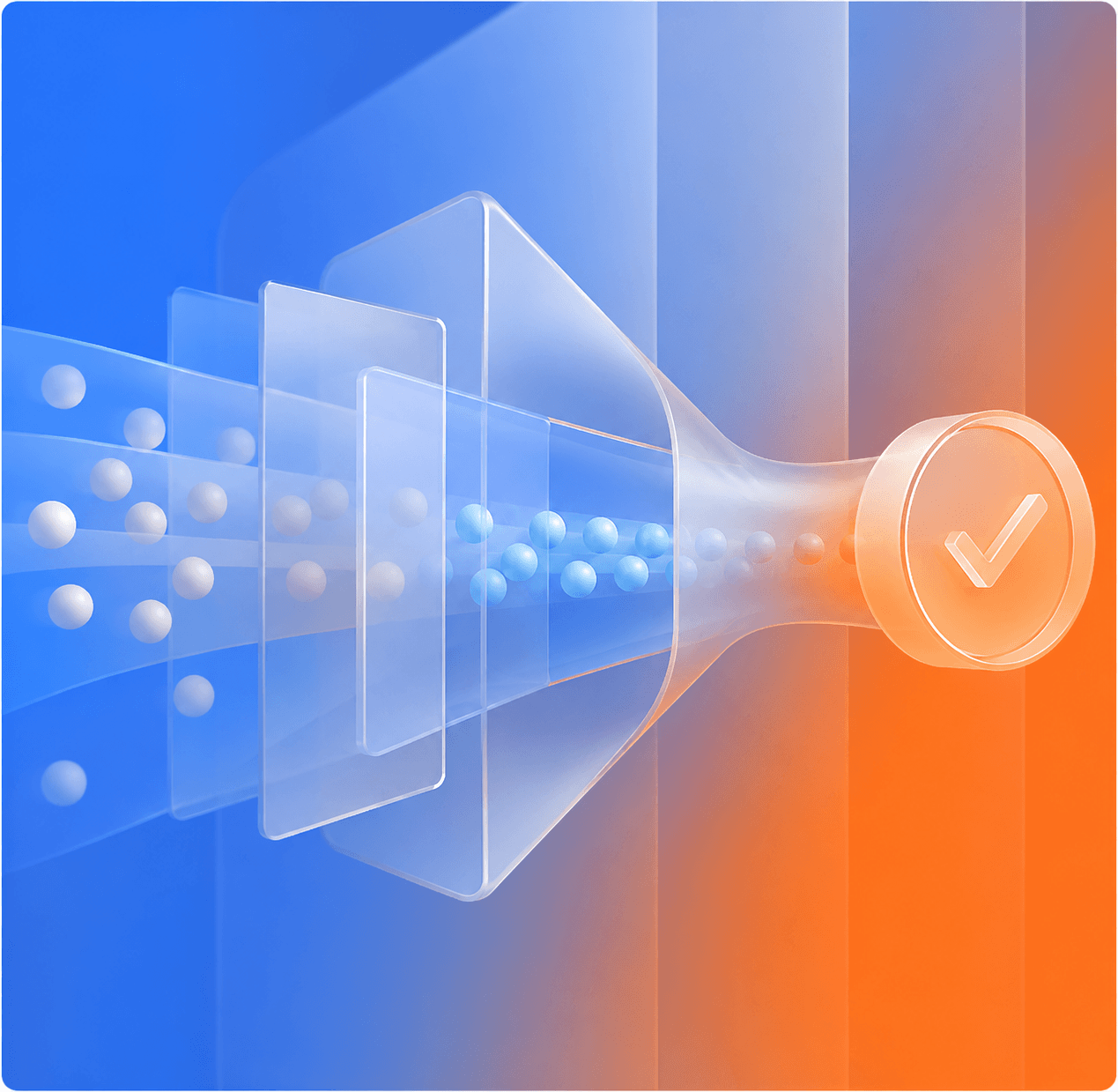
The shift that's happened in the last few years is the emergence of platforms built specifically to do this reconciliation work — aggregating from authoritative sources by line of business, resolving discrepancies, flagging gaps, and delivering the results in a format underwriters can actually use without becoming data scientists.
The LOB-specific logic matters here. A professional liability submission for a CPA firm warrants a different research pull than a commercial auto submission for a transportation company. The relevant sources — PCAOB vs. FMCSA, state license boards vs. DOT records, SEC filings vs. SAFER inspections — are entirely different. A useful research layer knows what to look for based on what's been submitted.
Pibit's ResearchCURE™, for example, structures external enrichment around the specific line of business and the details in the submission itself, pulling from authoritative regulatory databases, professional licensing boards, and safety records rather than generic web searches. The ground truth is always the submitted application — external data enriches and challenges that picture, rather than overriding it.
The output isn't a data dump. It's a validated set of insights: confirmed or conflicting information, flagged discrepancies, and traceable attribution so an underwriter can see exactly where each data point originated.
The Governance Dimension
There's a dimension to this that often gets underweighted in product conversations but matters a great deal at the portfolio level: documentation.
When an underwriting decision goes wrong — a large loss on an account that looked clean, a pricing error on a risk that should have been more expensive — the question that follows is always some version of: what did we know, and when did we know it? In a world where decisions are made from submission documents alone, that question is sometimes hard to answer clearly.
External data enrichment, done systematically, changes the audit trail. Every piece of information that influenced the decision has a source, a timestamp, and a reconciliation history. That's not a minor operational detail. For carriers operating across multiple programs, delegated authority structures, or regulatory environments that demand explainable underwriting decisions, traceable data provenance is increasingly a compliance requirement, not a nice-to-have.
What Changes When Carriers Operationalize This
The carriers that have moved to systematic external data enrichment — making it a standard input to the underwriting workflow rather than an exception for complex accounts — tend to describe similar improvements.
Appetite fit tightens. Submissions that would have cleared intake because the submission documents looked acceptable get flagged earlier, before time gets invested in them. Pricing discipline improves because underwriters are working from a fuller picture of risk. Loss ratio outcomes improve over time as better selection compounds.
The productivity effect is real too. Underwriters spending less time manually researching accounts — or worse, making decisions without the research — have more capacity for the analytical work that actually requires judgment.
According to carriers using end-to-end underwriting automation with integrated data enrichment, underwriting turnaround speeds improve by up to 85%, with measurable gains in GWP per underwriter and portfolio-level loss ratio performance.
The Account Is More Than the Application
The framing that seems to resonate most with underwriting leaders is simple: a submission tells you what the applicant wants you to know. External data tells you what the account actually looks like.
Neither perspective is complete on its own. Good underwriting has always required both. The question is whether the workflow is structured to deliver both — systematically, at scale, on every account — or whether the external view only gets assembled when someone has time to look.
For most commercial P&C carriers, the answer to that question is more honest than comfortable. And increasingly, it's the question driving investment in account intelligence infrastructure.
If you want to see how carriers are structuring submission research workflows in practice, explore our guide to submission triage and prioritization or read about how underwriting automation is reshaping commercial P&C operations. For a deeper look at the data enrichment layer specifically, our ResearchCURE™ solution page covers the LOB-specific approach in detail.
Frequently Asked Questions

AI & Underwriting Specialist


.png)

Ready to optimize